
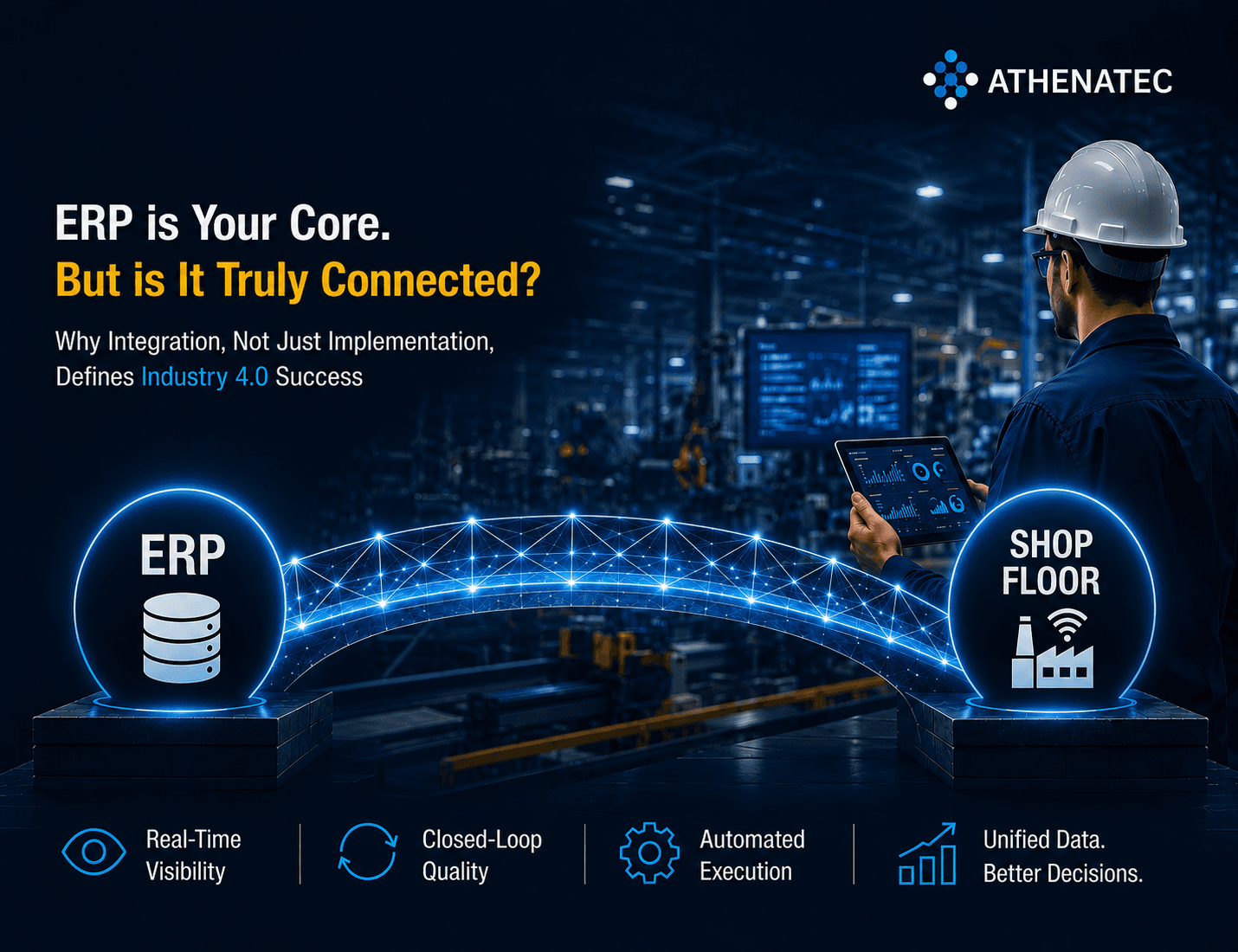
ERP is Your Core. But is It Truly Connected?
By Kumar Nallusamy, Athena Technology Solutions.
Why Integration, Not Just Implementation, Defines Industry 4.0 Success
The current reality in almost any manufacturing facility today, is that ERP forms the backbone. And rightfully so. Enterprise Resource Planning (ERP) systems, powerful platforms like Oracle EBS, have become the central nervous system for Financials, HR, SCM, Procurement, Manufacturing and Order Management. They tell you what happened, who ordered it, and what it cost.
But here is the uncomfortable question every forward-thinking manufacturer needs to ask themselves: If ERP is your core, is it truly connected to the rest of your body?
For a staggering number of organizations, the answer is no. Instead of a unified digital thread, they have a rigid core system surrounded by disconnected applications and manual processes. The result is and inefficient system, and it’s complete inability to compete in the era of Industry 4.0.
At Athena Technology Solutions, we have spent over ten years helping industry leaders fix this problem. Here is what we have learned: Implementation is just the starting point. Integration is what truly matters.
The Silent Productivity Killer: The Disconnected Ecosystem
Let us look at the typical manufacturing landscape. You have invested heavily in best-in-class systems:
- ERP (like Oracle EBS) for business planning and finance.
- CRM for customer relationships and sales forecasting.
- PLM for product design and engineering changes.
- WMS for warehouse logistics.
- MES for real-time production control.
Each of these systems is a masterpiece of efficiency within its own four walls. But when they do not talk to each other, they create data silo: isolated pools of information that strangle productivity.
Consider the life of a simple engineering change order. A designer updates a BOM (Bill of Materials) in the PLM. That change needs to update production schedules in the MES, procurement triggers in the ERP, and inventory slots in the WMS.
In a disconnected plant, this requires manual handoffs. Someone exports a spreadsheet from PLM, emails it to a production planner, who manually types changes into the ERP. This is slow, error-prone, and creates fragmented visibility. The CFO sees one cost picture in ERP while the plant manager sees another in MES. The CEO cannot trust either.
This gap is the primary reason digital transformation fails. You have automation in pockets, but no orchestration.
From Backbone to Brain: The Integration Bridge
This is where the definition of success shifts from “which software you buy” to “how well you connect it.” Integration is the bridge that turns a rigid backbone into an intelligent, responsive brain.
Industry 4.0 is not about having data; it is about having the right data at the right time in the right system. True integration, specifically connecting your ERP with a powerful Manufacturing Execution System (MES), unlocks this reality.
When ERP and MES are truly connected, real value is unlocked:
- Real-Time Visibility: The ERP no longer waits for end-of-day reports. It knows instantly when a production delay in the MES will impact a customer shipment date.
- Closed-Loop Quality: When a defect is detected on the shop floor (MES), the system automatically triggers a containment task in the ERP and logs the non-conformance against the specific lot.
- Automated Execution: Work orders flow seamlessly from ERP to MES. Labor, material, and machine data flow back to the ERP for real-time cost accounting. No manual entry. No lag.
The result is an operational revolution where you stop reacting to problems and start predicting and preventing them.
The Athena Approach: Connecting Your Core
At Athena Technology Solutions, our entire philosophy is built on this premise. While many consultants focus solely on “go-live” dates, we focus on “connect-live” outcomes. Our expertise lies in ensuring that your ERP is not an island, but an integrated hub.
We specialize in the seamless implementation of MES and its integration with all other enterprise systems, including complex ERP environments like Oracle EBS, PLM, and CMMS. Our team understands the deep, often messy reality of manufacturing data because we have lived it.
Take the example of a recent client in the electronics industry. They had a world-class ERP system, but their production team was flying blind. They suffered from chronic data mismatches between what finance thought was on the line and what actually was running.
By deploying our experts to integrate their Siemens Opcenter MES with their existing ERP, we eliminated the manual handoffs. The result was a unified data ecosystem where a change in engineering triggered an automatic update in procurement. Production delays were visible to sales before customers had to be called. Fragmented visibility was replaced by a single source of truth.
This is the bridge to digital transformation. It is what happens when you stop treating ERP as the final destination and start treating it as the core of a connected value chain.
The Road Ahead: Integration as a Strategy
As you plan your next technology investment, resist the temptation to simply buy another “best-of-breed” system to solve a single problem. Instead, ask a harder question: How will this connect to my core?
The winners in Industry 4.0 will not be the companies with the most expensive ERPs or the fanciest MES dashboards. They will be the companies that realize integration is the strategy. They will be the manufacturers who break down the silos, automate the handoffs, and finally achieve that elusive, real-time view of their entire enterprise.
Do not let your core become a bottleneck. It is time to truly connect.
Ready to bridge the gap between your ERP and the shop floor? Athena Technology Solutions specializes in making the complex, seamless. From MES implementation to deep enterprise integration, let’s build your bridge to Industry 4.0.
Contact our team today to start the conversation.