
Beyond the Software: Why Your MES Selection Needs a Blueprint, Not Just a Demo
Athena Technology Solutions
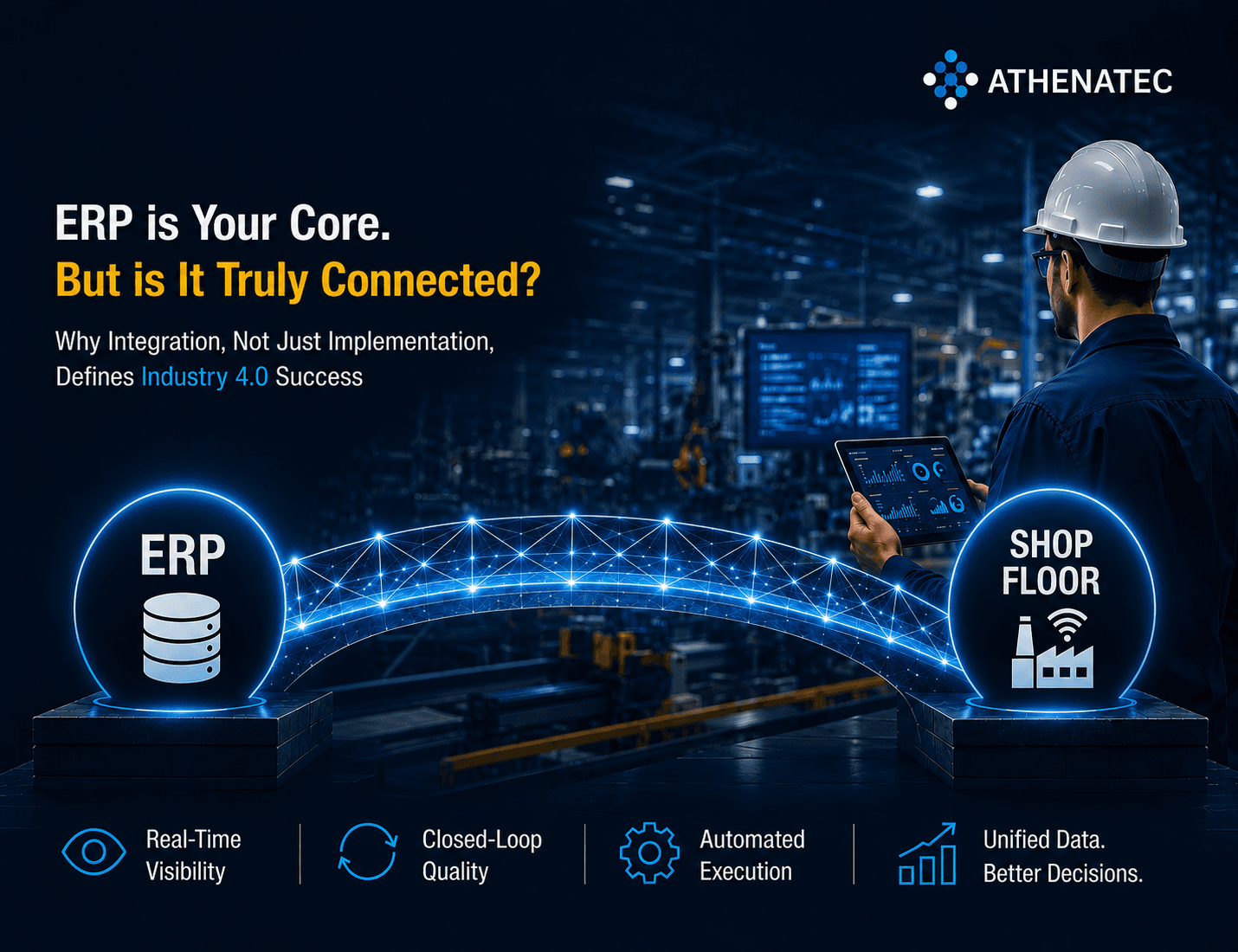
Selecting a Manufacturing Execution System (MES) is a pivotal moment for any manufacturer. It’s the bridge between your shop floor and your business strategy, promising real-time visibility, improved productivity, and streamlined operations. However, the market is crowded with powerful tools, and the difference between a successful digital transformation and a costly digital “paperweight” often comes down to the process of selection and the partnership during implementation.
We often meet manufacturers who have already done their homework. They know they need Siemens Opcenter. They understand its power in change management, quality control, and overall equipment effectiveness (OEE). But they face a common, critical question: “We know the destination, but how do we build the road to get there?“
This is where Athena bridges the gap. We provide the industrial expertise to ensure your selection is successful; we model your processes, coach your team, and de-risk your journey from Day One.
Here is how we partner with you through the MES selection and build-out process—and how Siemens’ robust capabilities support the mission.
The MES Selection: Process Over Promise
An MES implementation is not just an IT project; it is a business transformation. Before a single line of code is configured, the groundwork must be laid. Industry best practices show that successful implementations start with a clear definition of objectives and KPIs.
However, many selection processes get stuck comparing feature checklists rather than evaluating how the software will adapt to real-world chaos. When we talk about Siemens’ capabilities—such as Change Management (CEP 1082) —we look beyond the feature sheet. We look at how that tool enforces data integrity.
With Siemens, master data management ensures that every change to recipes, workflows, or instructions goes through a controlled review and impact analysis before deployment . But the question remains: How do you translate your 500-step tribal knowledge into that structured digital format?
The Athena Approach: Building Side-by-Side
You don’t need a consultant to disappear for six months and return with a finished system. You need a partner who works alongside your team, transferring knowledge, capturing best practices, and building confidence. This is the core of our philosophy.
Building a Robust Foundation: Key Siemens Capabilities
As we build these flows together, we leverage the deep functionality of the Siemens Xcelerator portfolio to ensure your foundation is solid. Beyond the core routing, we focus on critical modules that deliver immediate ROI:
- Change Management (CEP 1082): In a dynamic manufacturing environment, change is constant. With Siemens’ master data management, we help you enforce rigorous review and approval workflows. This ensures that when a specification or process changes, the impact is analyzed, approved, and deployed in a controlled manner across all plants, preventing costly errors .
- Statistical Process Control (SPC): Quality cannot be an afterthought. As we model your flows, we integrate SPC to provide real-time monitoring. Using the advanced SPC capabilities within OpCenter, we can set up control charts (like X-bar R or P charts) and apply Nelson rules to act as a “smoke detector” for your processes, catching quality deviations before they become mass defects . This allows the system to automatically trigger holds or alerts when processes drift .
- Label Printing & Traceability: An MES is only as good as its data accuracy. We configure robust label printing solutions integrated directly into the workflow. Whether you require 2D barcodes or serialization for digital product passports, we ensure that the right material gets the right label at the right time, eliminating manual errors and ensuring full end-to-end traceability .
De-Risking with a Proof of Concept (POC)
Even with the best planning, nothing builds confidence like seeing the system run on your equipment, with your data.
A structured PoC is the safest way to validate your MES strategy. Unlike a full-scale rollout, a PoC limits the scope—often to a single machine or work cell—to demonstrate feasibility . Athena can facilitate this by:
- Configuring the Siemens environment to capture specific signals (e.g., cycle times, start/stop signals).
- Running the system in parallel with your existing manual processes to visually demonstrate the advantages of digital data capture and analysis .
This approach provides decision-makers with tangible evidence of the software’s benefits and technical feasibility, making the business case for the full rollout undeniable.
Support During Build-Out: Training for the Real World
Finally, we address the human element. It is estimated that a significant number of MES projects struggle because training is generic and fails to address specific user roles. You wouldn’t train a machine operator and an IT technician the same way, so why would you train them on the MES the same way?
At Athena, we advocate for role-based, layered training.
- Operators learn the specific touchscreen interactions for their machine, how to handle exceptions, and how to log data accurately.
- Supervisors learn how to analyze dashboards, release work orders, and manage resources.
- IT and Engineers learn how to maintain the models we built together and expand the system to new lines.
By providing ongoing coaching and access to real-world resources, we ensure that the system adoption sticks.
Conclusion
Selecting an MES is a journey, not a transaction. By partnering with Athena, you gain more than a software implementer; you gain a team of industrial experts committed to your success. From building the first sample flow to coaching your team through the five-hundredth, we are there to ensure that your investment in Siemens technology delivers the operational excellence you set out to achieve.
Ready to move beyond the demo and start building? Let’s talk.